The Wagner Clan by Jonathan Carr
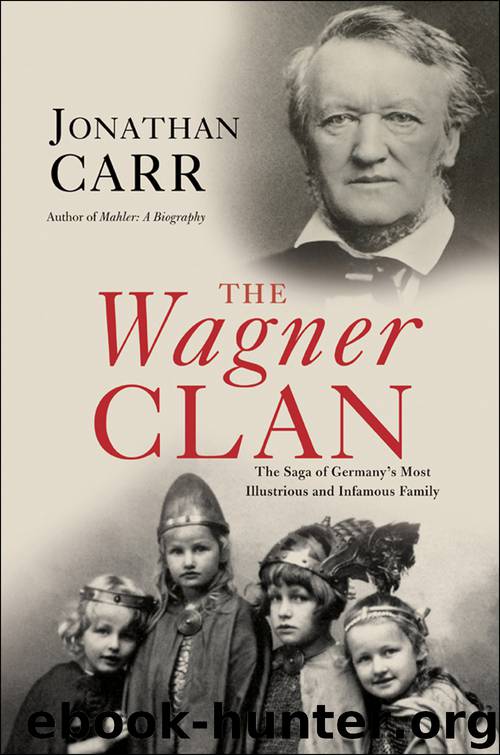
Author:Jonathan Carr
Language: eng
Format: epub
Publisher: Grove Atlantic
Published: 2007-09-17T04:00:00+00:00
When Wieland left home in the autumn of 1938 for an atelier in Schwabing, Munich’s bohemian quarter, the ‘thousand-year Reich’ was little more than five years old. In that brief span the Nazis had worked to transform Germany at giddy speed as though rightly sensing that they did not have a millennium of power before them after all. Foul though they were, the events of 1933 like the burning of books, the ‘coordination’ of culture and the (only partly effective) boycott of Jewish shops were just the first steps down a trail of blood and terror. Others quickly followed. In 1934 Hitler consolidated his power in the ‘night of the long knives’, using the regular army and SS to crush the SA, the near-independent stormtrooper force of his rival and erstwhile friend Ernst Röhm. Röhm himself was murdered along with scores of other alleged ‘traitors’ – some unconnected with the SA but (like ex-chancellor Kurt von Schleicher) thought ripe for elimination anyway by Hitler and his main accomplices, Göring and Himmler.
A year later new action was taken against Jews, already chased from the civil service and for the most part from the professions and the arts. Under the 1935 ‘Nuremberg Laws’ that notoriously claimed to define Jews by race rather than religion, they were now deprived of their civic rights and marriages were forbidden between them and ‘citizens of German or kindred blood’. Tens of thousands emigrated but, disastrously, many stayed put for years until the trap snapped shut on them. When Hitler came to power Germany’s Jews had totalled some half a million (less than one per cent of the population) and despite every villainy, most of them continued to look on Germany as their home. Besides, the cost of leaving was high and the prospect of being welcomed elsewhere with open arms small. After each new stage of persecution Jews tended to believe the nadir had been reached and each time they were wrong. In 1936 they were indeed harassed less overtly because the Nazis did not want to revolt foreigners visiting the Olympic Games in Berlin. But once the Games were over hostility mounted again, reaching a new but far from final peak of violence on 9–10 November 1938, the so-called Kristallnacht (literally ‘crystal night’ or ‘night of broken glass’), when hundreds of synagogues were gutted countrywide and thousands of Jewish homes and shops ransacked. Close to a hundred Jews were murdered and up to thirty-five thousand others thrust into concentration camps, raising the number of inmates to around sixty thousand in one swoop. Four months earlier, at the United States’ behest, a thirty-two-state conference had been held in Evian, France, to address the plight of Jewish refugees. It took no firm action.
Although Jews were the main targets they were not, of course, the only ones to suffer. Real and imagined foes of the regime were hounded down, tortured and slaughtered; ‘inferior elements’ including gypsies, homosexuals and the mentally handicapped were sterilised or used as ‘guinea pigs’ for odious medical experiments.
Download
This site does not store any files on its server. We only index and link to content provided by other sites. Please contact the content providers to delete copyright contents if any and email us, we'll remove relevant links or contents immediately.
The Goal (Off-Campus #4) by Elle Kennedy(13673)
Kathy Andrews Collection by Kathy Andrews(11831)
Diary of a Player by Brad Paisley(7581)
Assassin’s Fate by Robin Hobb(6216)
What Does This Button Do? by Bruce Dickinson(6207)
Big Little Lies by Liane Moriarty(5804)
Altered Sensations by David Pantalony(5104)
Pale Blue Dot by Carl Sagan(5008)
Sticky Fingers by Joe Hagan(4198)
The Death of the Heart by Elizabeth Bowen(3622)
The Heroin Diaries by Nikki Sixx(3550)
Confessions of a Video Vixen by Karrine Steffans(3309)
Beneath These Shadows by Meghan March(3308)
How Music Works by David Byrne(3270)
The Help by Kathryn Stockett(3147)
Jam by Jam (epub)(3092)
Harry Potter 4 - Harry Potter and The Goblet of Fire by J.K.Rowling(3073)
Computational Linguistics and Intelligent Text Processing: 20th International Conference, CICLing 2019 La Rochelle, France, April 7â13, 2019 Revised Selected Papers, Part I by Alexander Gelbukh(2995)
Strange Fascination: David Bowie: The Definitive Story by David Buckley(2872)
